Moving Heavy Loads Faster — Without Creating a Bottleneck
When pallet movement becomes part of the production process, the conveyor is no longer just a transport system.
It becomes a critical part of the production cycle.
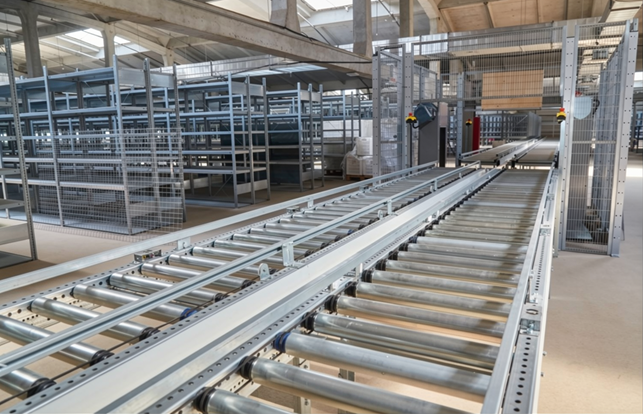
For this project, the client needed to move pallets between two production zones over a distance of approximately 45 meters.
The objective was clear:
Increase pallet-handling capacity while maintaining the speed required to keep the production flow moving.
But this created an interesting engineering challenge.
The pallets were heavy, yet they needed to travel at relatively high speed. A conveyor designed only for the load would not necessarily be sufficient — the structure, rollers, bearings, guidance system and dynamic behavior all had to work together.
The challenge
The conveyor route also included a scanner in the middle of the line.
Once a pallet reached the scanning point, its destination was determined and the pallet had to be directed along the correct path.
This meant the system had to combine:
Heavy-load handling + high-speed movement + accurate pallet guidance + automated routing.
And there was very little room for the conveyor itself to become the bottleneck.
Our engineering approach
We started from the load and the required operating speed and worked backwards through the mechanical design.
The conveyor structure was engineered with the rigidity required to maintain alignment under heavy pallet loads and dynamic operating conditions.
We selected high-load-capacity bearing and roller components capable of handling the required radial loads, while also considering the axial forces generated during pallet movement and guidance.
But supporting the pallet was only half of the problem.
At higher speeds, controlling the pallet becomes just as important as moving it.
For this reason, we developed a flexible guiding arrangement capable of keeping the pallets correctly aligned while accommodating the dynamic movement of the load.
The result was a conveyor system designed not simply to carry the pallets, but to keep them stable, controlled and correctly positioned at operating speed.
The result
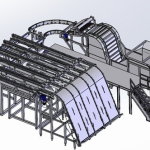
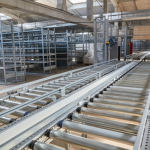
Two new pallet conveyors were integrated into the production flow, providing approximately 45 metres of controlled pallet transportation between the two zones.
The system incorporated the scanning and routing point, allowing pallets to be automatically directed toward their required destination.
Most importantly, the solution increased the handling capacity while helping prevent the pallet-transfer section from becoming a production bottleneck.
This is how we approach tasks
We don’t start by asking:
“What conveyor should we use?”
We start by asking:
What is the load?
How fast must it move?
What forces will the system experience?
How will the pallet behave dynamically?
Where can a bottleneck occur?
How will the system integrate with the automation?
Then we engineer the machine around those answers.
Load → Speed → Forces → Structure → Components → Guidance → Automation → Integration
Because a conveyor for heavy pallets is not simply a collection of rollers.
It is a mechanical system designed around load, speed, control and production flow.